What to Look for When Choosing Loan Processing Software for Your Bank

The Cost of Legacy Loan Origination
Legacy loan origination software appears economical on a quote, but the true cost surfaces quickly. Implementation alone typically runs six figures, and a single configuration change can trigger a five-figure invoice. For credit unions, this fee structure is less about service and more about lock-in. Every contract revision becomes a barrier, chaining you to an aging system while market pressures mount. Consider the reality: fintechs, unfettered by legacy contracts, now control nearly 40% of the consumer loan market, while the number of federally insured credit unions has plummeted over 30% in a decade. These stats reflect an industry watching borrowers choose speed over loyalty. Fuse breaks this cycle with a modern alternative. No implementation fees, no configuration tolls, and a flat annual rate that stays predictable. Our automation delivers approximately 1% automation growth per week, with average customer outcomes reaching 71% annual automation. We guarantee new integrations in under a month and weekly product releases—contractually. The era of borrowing from yesterday to pay for tomorrow ends here. Your credit union can reclaim its edge, without the legacy tax.
The High Price of the Status Quo
Legacy loan processing software vendors often demand six-figure implementation fees before a single loan is booked. Five-figure tolls for basic configuration changes mean adapting your own system carries a hefty surcharge. Contract friction becomes lock-in: every adjustment requires vendor sign-off, months of waiting, and invoices that make switching seem like the only escape. Meanwhile, fintechs move faster, and credit unions lose share to competitors who treat members like customers, not captives.
Proof From Credit Unions That Switched

Concrete numbers tell the story better than promises. When credit unions move from legacy loan processing software to Fuse, the results show in days and minutes, not quarters.
Vibrant Credit Union, through the Drivata auto-lending CUSO, cut funding time from three days to 1.2 minutes. Indirect volume grew over 40% as a result. The change did not require a new core or a large internal IT project.
Canopy Credit Union, a $200 million CDFI, had been unable to turn on auto-decisioning under its prior LOS for five years. After switching to Fuse, it expects to reach 40% auto-decisions within six months. For a lean team, that shift frees underwriters for exceptions rather than routine approvals.
Navigant Credit Union ($4 billion in assets) launched a fully automated credit card program with end-to-end auto-decisioning on core data. No manual intervention is required for standard applications.
Across Fuse's client base, the typical customer achieves approximately 71% automation in the first year. That is an average customer outcome, not a contractual guarantee. It works out to roughly 1% new automation each week, driven by the dedicated Automation Coach who meets with every client every two weeks to identify the next highest-impact workflow to automate.
What Fuse Actually Guarantees
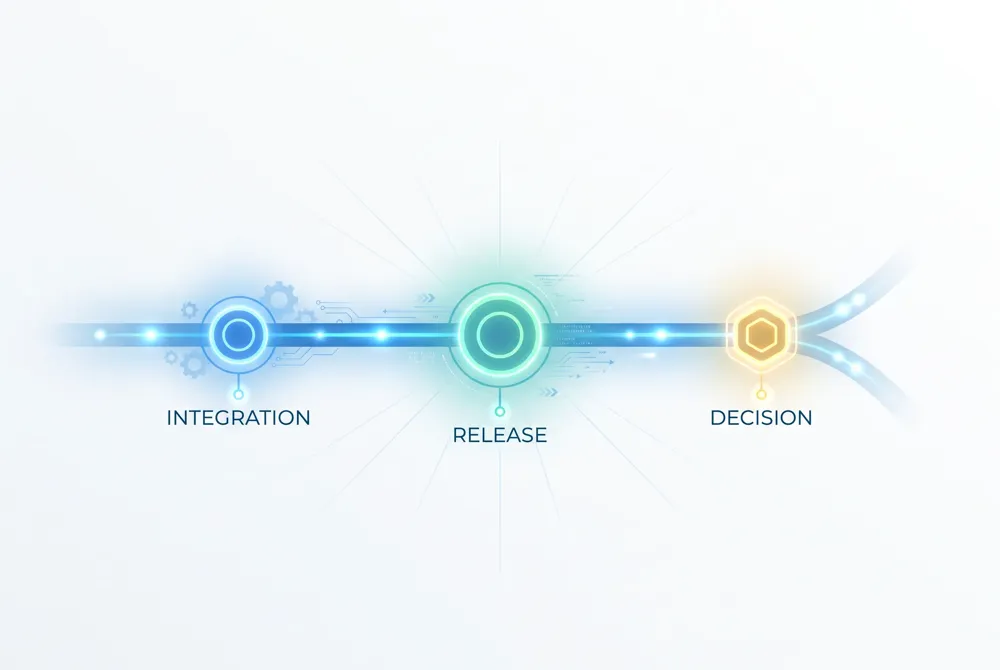
Most loan origination software vendors make broad promises about automation and speed. Fuse takes a different approach. Its contractual commitment, called Automation Guaranteed, covers three specific items and nothing more.
- New integrations delivered in under one month at no extra cost.
- Weekly product releases.
- The ability to auto-decision on 100% of core data fields.
These three guarantees are written into every Fuse contract. The pricing is flat at $100,000 per year ($50,000 for smaller credit unions), with $0 implementation and $0 variable fees. There are no surprise charges for configuration changes or new integration requests.
The average Fuse client reaches approximately 71% automation in the first year, or about 1% new automation per week. This is a typical customer outcome, not a contractual promise. What is guaranteed is the platform's ability to auto-decision on every field your core system provides, the cadence of weekly updates that add new capabilities, and the assurance that any new integration your institution needs will be built and delivered within a month.
For institutions evaluating loan processing software, this level of transparency matters. Legacy vendors often charge five-figure tolls for basic configuration changes and delay integrations for months. Fuse's model removes those barriers upfront.
Flat Pricing With No Surprises

Pricing is flat at $100,000 per year for most institutions and $50,000 for smaller credit unions. Implementation costs $0. There are no variable fees. Every LOS vendor eventually reveals its true cost through implementation fees, per-seat charges, and variable tolls for basic configuration changes. Fuse takes a different approach.
This structure is not success-based or outcome-based. It is a simple annual subscription. A credit union knows exactly what it pays from day one, no matter how many loans it processes or how much automation it deploys. For the buying audience that has endured six-figure implementation invoices from legacy vendors, that clarity alone is a differentiator.
The flat fee covers the full Fuse platform: the applicant portal, decision engine, document automation, agent workspace, and account opening. It includes the Automation Coach, weekly product releases, and integrations delivered in under one month at no extra cost. No per-user upcharge. No per-module markup. One price for the entire system.
Why Fuse Beats the Legacy Category
Fuse is not a peer of legacy loan origination platforms. It is the modern alternative purpose-built to replace them.
Legacy platforms such as MeridianLink, Origence, and nCino often require separate systems for consumer, commercial, and indirect lending. Fuse replaces that fragmented stack with a single system spanning the applicant portal, decision engine, document automation, agent workspace, and account opening.
A credit union running on a Fiserv or Jack Henry core can deploy Fuse on top of that core without replacing it. Fuse ships with 200 pre-built integrations and connects to existing core data, so auto-decisioning works on 100% of core fields.
Fuse's AI agents perform narrow, well-defined tasks: document reading, data extraction, fraud verification, and outbound borrower communications. They do not attempt to learn or improve over time. They apply configured rules and AI inference at the point of action, giving staff clear audit trails and explainable decisions.
Real outcomes, not roadmaps
Vibrant Credit Union cut funding time from three days to 1.2 minutes through Fuse's automation. Navigant Credit Union launched a fully automated credit card program with end-to-end auto-decisioning on core data. A single platform replaced what prior vendors handled in separate modules, with weekly product releases and flat pricing.
Built Only for Community Institutions
Fuse is built for a specific audience. The platform's primary focus is credit unions. Community banks and finance companies serving similar member bases are a secondary fit.
The system is not designed for auto or powersports specialty lenders, fintech lenders, or non-bank consumer finance startups. Those organizations have different volume profiles, core requirements, and compliance obligations. Fuse's architecture, integrations, and support model are tuned for traditional financial institutions that serve local communities.
This focus shows in the details. A credit union on a Fiserv core can run Fuse on top of it without replacing the core. The platform's pre-built integrations cover the cores, credit bureaus, and third-party services that community institutions actually use. Fuse also backs its commitment with the $5M Rescue Fund, offering free use of the platform to qualifying credit unions until their existing LOS contract expires. After that transition, pricing is a flat annual fee with no variable charges.
The Proof Behind the Platform
Fuse serves more than 100 financial institutions and has earned several marks of external validation that signal credibility for a new LOS.
The Rescue Fund and the FIS Partnership
In March 2026, Fuse launched the $5M Fuse Rescue Fund, offering free platform use for the first 50 qualifying credit unions until their existing loan processing software contract expires. The offer removes the financial obstacle that locks so many institutions into legacy systems.
One month earlier, in January 2026, Fuse became an officially resold product of FIS, one of the largest core banking providers in the world. A credit union on a Fiserv core can run Fuse on top of it, and the FIS relationship gives Fuse a distribution channel that most competitors lack.
Industry Recognition and Investor Backing
Fuse received the 2026 Callahan Innovation Award for Reimagining the Lending Experience, a recognition from the credit union industry's leading analyst firm. The company has raised over $25M from Footwork, Primary Venture Partners, NextView Ventures, Commerce Ventures, FJ Labs, and Clocktower, the investors behind Chime and OpenAI.
For executives evaluating a new LOS vendor, these signals add up: a rapidly growing client base, an award from the analyst your board likely trusts, a deep-pocketed investor roster, and a strategic partnership with the largest core provider in the industry.
How to Evaluate Your Next LOS
A vendor evaluation should start with hard questions about costs that move after the contract is signed. Ask about implementation fees and configuration change tolls. Many legacy vendors charge five figures for basic workflow changes after go-live. Fuse charges $0 for implementation and $0 for variable fees, and ships weekly releases at no extra cost.
When a vendor presents an automation rate, ask whether that number is an average outcome or a contractual guarantee. Fuse's customers achieve on average approximately 1% new automation per week, or roughly 71% in the first year. What Fuse does guarantee in writing is that new integrations will be delivered in under one month at no extra cost, that the product ships weekly, and that the platform can auto-decision on 100% of core data fields.
Confirm exactly which core data fields the system can auto-decision against. Many platforms limit auto-decisioning to standard fields like credit score or debt-to-income. Fuse auto-decisions on any core data field, including custom attributes and charge-off history, removing a common bottleneck.
Determine whether the platform sits on top of your existing core or requires a core replacement. Fuse runs on top of Fiserv, Jack Henry, Corelation, and other core systems. A credit union on a Fiserv core can deploy Fuse without migrating off the core, preserving existing infrastructure while gaining fintech-grade automation.
Your Next Step With Fuse
The data is clear: legacy loan processing software costs far more than the contract price. Fuse offers an alternative built for credit unions, with flat pricing at $100,000 per year for most institutions ($50,000 for smaller CUs), weekly product releases, and a contractual guarantee that new integrations ship in under one month at no extra cost.
See the proof in action. Read the Fuse Rescue Fund release to understand how qualifying credit unions get the platform free until their existing LOS contract expires. Review the Navigant Credit Union or Canopy Credit Union case studies to see real outcomes.
Ready to move forward? Request a 30-minute walkthrough with the Fuse team and see how the platform fits your institution's lending operations.
Related articles

7 Features to Look for in a Modern Consumer Lending Platform

Whole life insurance vs term life insurance: Which is the better choice for you?
What to Look for When Choosing Loan Processing Software for Your Bank
Ready to meet the AI-powered Loan Origination System?

