What Digital Transformation in Banking Means for Loan Origination and Underwriting
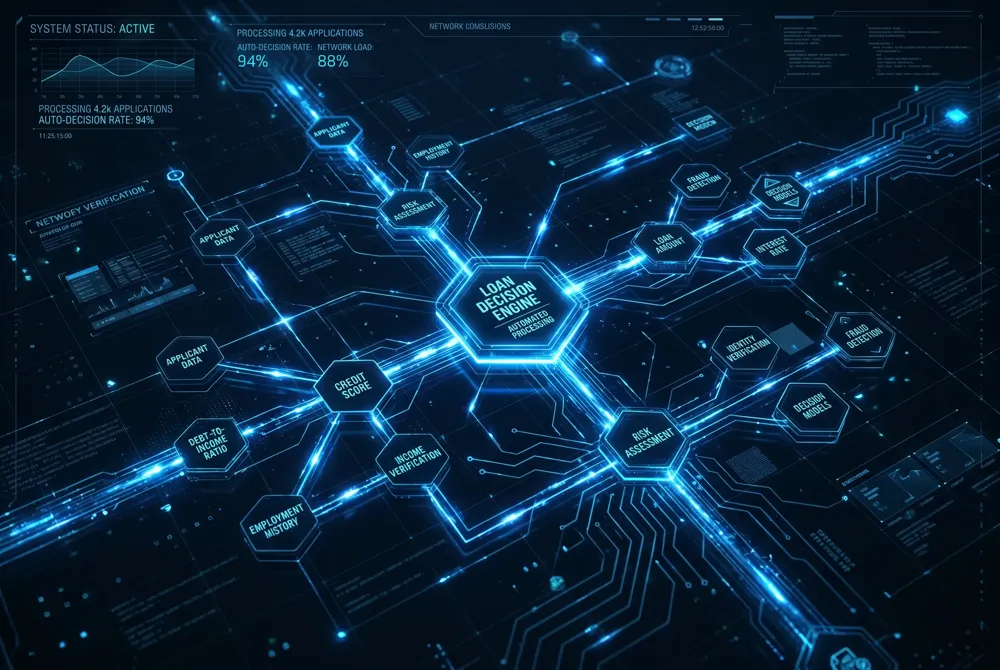
From Paper to Pixels: Rethinking Loan Origination
For most traditional credit unions, the loan origination process still resembles an assembly line of paper forms, manual data entry, and handoffs between disconnected systems.
Digital transformation means integrating digital technology into every area of operations, fundamentally changing how institutions operate and deliver value to members. It replaces paper-based, manual workflows with automated, data-driven systems that improve efficiency and reduce costs. At its core is modern loan origination software that spans application intake, credit scoring, underwriting, documentation, compliance checks, decisioning, and funding.
Legacy LOS platforms from providers like MeridianLink and Origence, or core-provided modules from Jack Henry and Fiserv, were never built for this level of integration. They create bottlenecks, lock institutions into long contracts, and charge six-figure implementation fees plus ongoing tolls for basic configuration changes. Fuse replaces those fragmented stacks entirely with a single system that includes an applicant portal, decision engine, document automation, agent workspace, and account opening.
The Five Pillars of Digital Transformation

Digital transformation is not one project. It is five distinct areas of change that must work together. For credit unions evaluating a new loan origination software implementation, understanding these pillars helps separate genuine progress from surface-level upgrades.
Process transformation streamlines workflows and automates manual tasks. This is where an automated underwriting system replaces spreadsheet-based credit analysis and paper document handling. Process transformation directly addresses that drag. Business model transformation redefines how value is delivered. Branch-heavy institutions are adopting digital-first models. Domain transformation means expanding into adjacent markets or product lines that were previously out of reach. Cultural transformation shifts internal mindsets toward continuous improvement. Operational transformation optimizes back-office functions, often through AI agents that handle document validation, fraud verification, and outbound borrower communications.
Fuse is built to support all five pillars from a single platform. The typical Fuse client achieves on average approximately 1% new automation per week, or roughly 71% in the first year. That is process and operational transformation working together. Flat pricing at $100,000 per year ($50,000 for smaller credit unions) with $0 implementation removes the business model friction that legacy vendors build into their contracts.
What each pillar means for your institution
| Pillar | Core Focus | How Fuse Delivers |
|---|---|---|
| Process | Automate manual workflows | AI agents auto-decision on 100% of core data fields |
| Business Model | Shift to digital delivery | Flat fee, no per-loan charges, weekly product releases |
| Domain | Enter new lending markets | 200+ pre-built integrations launch new products quickly |
| Cultural | Adopt continuous improvement | Dedicated Automation Coach, bi-weekly cadence |
| Operational | Optimize back-office | Document reading, fraud verification, outbound comms |
What Digital Transformation Really Looks Like

Digital transformation is the process of integrating modern technology into every layer of operations, from the member-facing portal to the core decision engine. For lending, this means replacing paper-based, manual processes with automated, data-driven systems that improve efficiency, reduce costs, and deliver a better experience for members. Institutions that have made this shift can process loan applications in minutes instead of days.
A clear example of what this looks like in practice comes from Navigant Credit Union, a $4 billion institution based in Rhode Island. Using a modern loan origination software platform with an integrated automated underwriting system, Navigant launched a fully automated credit card program. The system makes end-to-end credit decisions on core data without any manual intervention. For the credit union's members, the result is near-instant approvals. For the institution, it means lower operating costs and the ability to scale lending without adding headcount.
This is not a small-budget experiment. Navigant is a billion-dollar institution that chose to move away from fragmented legacy tools and adopt a single, AI-native platform. The shift allowed the credit union to deliver fintech-grade speed while staying true to its cooperative structure. That is the real promise of digital transformation: traditional institutions can compete with digital-first lenders using the right technology, without becoming fintechs themselves.
How an Automated Underwriting System Works

An automated underwriting system replaces human judgment with machine learning algorithms that evaluate loan applications in real time. Instead of checking a short list of rules, these models analyze hundreds of data points simultaneously, including credit bureau reports, income, debt-to-income ratios, and charge-off history.
The critical difference from traditional rule-based scoring is that machine learning captures nonlinear relationships between variables. A rule-based system might say “if DTI > 43% then deny.” An ML model can weigh dozens of interacting factors, identifying complex relationships that a fixed formula would miss. The NCUA has confirmed that an automated loan underwriting system (ALUS) may make decisions based on board-adopted criteria without human intervention at the time of decision.
The system outputs a decision in milliseconds. When an application does not meet the system's criteria, it issues a “Refer” recommendation rather than a final denial. This means a human underwriter can review the file for compensating factors. The system also generates compliant adverse action reports automatically, satisfying ECOA and FCRA disclosure requirements.
A fully automated system can approve loans that meet its configured thresholds and flag the rest for manual review. Fuse, for example, applies this approach to auto-decision on 100% of core data fields, including custom attributes and charge-off history, which allows lenders to scale approved volume without adding underwriting headcount. The system does not learn or improve from past decisions; it applies configured rules and AI inference at the point of action, with compliance checks built into every step.
Seven Trends Driving Digital Lending Innovation
Digital transformation is often described in terms of back-office efficiency, but the real driver is what members expect from their financial relationships. Analysts have distilled these expectations into seven distinct trends: Customizable, Connected, Live, Contextual, Green, Social, and Lifetime Banking. Each one directly shapes how a credit union should evaluate its loan origination software and the capabilities of an automated underwriting system.
Customizable and Contextual Banking
Members want loan products they can tailor to their situation, and they expect those options to appear at the right moment. Customizable banking means offering flexible terms, payment schedules, and product features without forcing a member into a rigid template. Contextual banking goes a step further by using data to present the right offer while the member is already engaged. A modern loan origination system supports both by applying rules based on member behavior, life events, and real-time credit data. Fuse enables this through auto-decisioning on any core field, including custom attributes, so a credit union can configure offers that adapt without manual intervention.
Connected and Live Banking
Connected banking breaks down silos between channels, allowing a member to start an application on a mobile device and finish it at a branch without re-entering data. Live banking means real-time updates at every stage. An automated underwriting system is central to both. It can pull credit bureau data, verify income, and return a decision in seconds. That speed transforms the member experience. Vibrant Credit Union cut funding time from three days to 1.2 minutes through the Dravada CUSO running on Fuse, and indirect volume grew over 40 percent.
Legacy systems from MeridianLink, Origence, or core-provided modules from Jack Henry and Fiserv were not built for this level of connectivity. They require manual data entry and batch processing. Fuse sits on top of a credit union's existing core and replaces those fragmented LOS modules with a single platform that delivers real-time data access and automated workflows.
Green, Social, and Lifetime Banking
Green banking reflects member demand for sustainable lending practices, such as preferred rates on energy-efficient vehicles or home improvements. Social banking means the institution demonstrates community impact, a natural strength for credit unions. Lifetime banking captures the goal of serving a member across every life stage, from a first auto loan through a mortgage to retirement products.
None of these trends can be delivered effectively with a static loan origination platform that requires weeks of configuration for every new product. The typical Fuse client achieves roughly one percent new automation per week on average. That pace lets a credit union quickly roll out a green auto loan program, adjust underwriting rules for a social banking initiative, or add a new product for a different life stage without waiting for vendor professional services.
What these trends mean for your institution
A 2024 study from ScienceDirect confirms that digital transformation depends on replacing fragmented legacy stacks with integrated systems. The seven trends above require an automated underwriting system that can apply board-approved criteria instantly, an LOS that configures without code, and a vendor that ships updates weekly. Fuse meets all three. Its contractual Automation Guarantee delivers new integrations in under one month, weekly product releases, and the ability to auto-decision on 100 percent of core data fields.
To see how these trends apply to your credit union's lending strategy, request a 30-minute walkthrough of the Fuse platform today.
Underwriting at a Credit Union in the Age of AI
Underwriting at a credit union has always meant evaluating a member's whole financial picture: credit history, income, debt-to-income ratio, employment stability, and often the length and depth of the member's relationship with the institution. The personalized, member-centric approach that defines credit unions relies on underwriters who understand their community and can weigh factors a rigid scorecard might miss.
An automated underwriting system does not replace that judgment. It handles the first pass: pulling credit reports, comparing scores to board-approved criteria, checking debt ratios, and flagging applications that meet the rules for auto-approval or need a human review. This lets loan officers spend their time on the cases that need their judgment rather than on data entry. The result is faster decisions and more consistent application of policy across every member.
NCUA guidance on automated systems
The NCUA has long confirmed that credit unions may use automated loan systems for underwriting and funding, as long as the system applies board-adopted criteria and the institution meets safety-and-soundness and fair lending requirements. A 2010 legal opinion permits a fully automated system that pulls a credit report, compares the score to underwriting criteria, and funds the loan on that score alone, without human intervention at decision time.
Key requirements from NCUA opinions include segregation of duties (the same employee cannot both enter data and disburse funds, unless the system handles the approval without that employee's discretion), and human oversight of any application the system would deny. An August 2023 NCUA reminder also warned credit unions to review system settings for prohibited-basis discrimination: including age or marital status as parameters for manual underwriting exceptions can violate the Equal Credit Opportunity Act.
A modern LOS handles these compliance requirements by design. Built-in audit trails document every step. Configurable rules apply regulatory changes automatically. For credit unions on legacy systems where manual review was the only option, switching to an automated underwriting system that respects the member-centric model while processing applications in seconds is the practical next step in digital transformation.
The Four Stages of Digital Transformation Maturity
Digital transformation is not a single project. It unfolds across four distinct stages, each with its own goals, risks, and technology requirements. Understanding where your institution sits on this maturity curve is the first step toward a practical roadmap.
Stage 1: Stabilization
Most credit unions begin here. The focus is on securing legacy systems, patching vulnerabilities, and standardizing data formats across the core. At this stage, the loan origination software in use is likely a core-provided module from Jack Henry or Fiserv. The goal is not innovation. It is reliability and compliance.
Stage 2: Continuation
Institutions extend digital reach without replacing the underlying platform. They add member-facing portals, mobile deposit, and online applications. A typical continuation project might deploy a digital front-end on top of an existing automated underwriting system. Manual handoffs between systems remain common, and operational silos persist.
Stage 3: Modernization
This is the hard stage. Modernization means replatforming core systems, migrating from on-premise to cloud-native infrastructure, and replacing fragmented LOS modules with a single end-to-end platform. It demands organizational alignment, budget authority, and a vendor that can deliver on time. Fuse is built for this stage. Its single-tenant, SOC 2 compliant platform replaces the legacy stack entirely, with 200+ pre-built integrations and no-code configuration for business users.
Stage 4: Innovation
At this stage, technology enables new business models. Lenders launch fully automated credit card programs, auto-decision on 100% of core data fields, and use AI agents for document reading, fraud verification, and outbound communications. This is where the concept of straight-through processing becomes real. Navigant Credit Union reached this stage with an end-to-end automated credit card program. Vibrant Credit Union, through its CUSO, cut indirect funding time from three days to 1.2 minutes.
The maturity gap
According to McKinsey, only 30% of credit unions that have undergone a digital transformation report successfully implementing their digital strategy; the majority fall short of stated objectives. The gap is not a technology problem. It is an execution problem.
The sequence matters. Skipping stabilization invites compliance risk. Staying in continuation indefinitely locks in operational drag. Modernization requires a platform that can carry an institution from Stage 3 into Stage 4 without another forklift upgrade. Fuse's Automation Guarantee helps bridge that gap: new integrations are delivered in under one month, product ships weekly, and the system can auto-decision on every core data field.
For credit unions evaluating their current stage, the practical question is simple: can your existing loan origination software support the next stage without a full replacement? If the answer is no, the decision to move becomes a matter of timing, not technology.
From Paper Chase to Straight-Through Processing
A typical mortgage loan generates hundreds of pages of documentation. At most financial institutions, those pages are still sorted, verified, and rekeyed by hand. The errors and delays that follow are not minor inefficiencies. They are the difference between a member funded in days and one who walks to a competitor.
Intelligent document automation solves this at the point of capture. Tools using OCR and AI classification extract data, validate it against known formats, and route it into the system without a human keystroke. New documents are classified automatically, even when formats vary, because machine learning models recognize content patterns instead of fixed templates.
The impact scales. Better Mortgage processes over 95% of its loan documents through automated tools, allowing its underwriting team to focus on exceptions instead of data entry. At Vibrant Credit Union (via the Dravada auto-lending CUSO), funding time dropped from three days to 1.2 minutes after automation replaced manual document handling. Indirect volume grew more than 40% as a result.
The path to straight-through processing is not all-or-nothing. A dedicated Automation Coach can identify the next highest-impact workflow to automate, week by week. The typical Fuse client automates approximately 1% of remaining manual steps per week, or roughly 71% in the first year. That cumulative effect turns a paper chase into a fully digital pipeline.
Why Legacy Tech Holds Lenders Back
Most credit unions and community banks run their lending on fragmented stacks. A typical institution uses separate systems for the member portal, the decision engine, document management, and account opening. These are often modules bolted onto a core system from Jack Henry, Fiserv, or Corelation, or older platforms like MeridianLink and nCino that were not designed for modern digital workflows.
The result is data trapped in silos. When core systems do not share data cleanly, staff rekey information, errors multiply, and decisioning slows. Research from Gresham shows that 68% of credit unions face penalties at least once a year due to poor data quality within the firm. A fragmented stack turns data integrity into a recurring compliance risk.
A 2025 McKinsey report found that large credit unions are 40% less productive than digital natives, and product rollout cycles take 4 to 6 months for traditional institutions compared to two to four weeks for fintechs. Only 30% of credit unions that undergo a digital transformation successfully implement their strategy; the majority fall short of stated objectives. The gap is not a technology problem alone. It is a stack problem.
Fuse replaces the fragmented legacy stack with a single platform that spans the applicant portal, decision engine, document automation, agent workspace, and account opening. The system ships with 200+ pre-built integrations to core providers, so data flows between systems without manual bridges. Business users configure rules and workflows with no code. The contract guarantees new integrations in under one month, weekly product releases, and the ability to auto-decision on 100% of core data fields.
Cloud-Native Architecture and AI-Native Design
Cloud-native loan origination software reduces IT overhead, delivers automatic updates, and provides real-time data access with built-in scalability. This shift is central to digital transformation.
AI-native systems take automation further. In a modern LOS, narrow AI agents handle document reading, data validation, fraud verification, and auto-decisioning based on configured rules. The NCUA has confirmed that federal credit unions may use fully automated underwriting for small loans, provided regulatory safeguards are met.
Fuse’s platform is single-tenant, SOC 2 compliant, and releases weekly. Business users configure rules and workflows in a no-code interface, so lenders don’t need IT support to adjust lending criteria.
Making the Switch Without Breaking the Bank
Switching loan origination software has historically meant two painful outcomes: a six-figure implementation bill and months of disruption. Legacy vendors charge for every integration, every configuration change, and every data migration. That model creates lock-in, not loyalty. A growing number of credit unions are rejecting it.
Flat pricing, zero implementation cost
Fuse charges a flat annual fee of $100,000 ($50,000 for smaller credit unions) with $0 implementation and $0 variable fees. There are no per-loan charges, no success-based fees, and no tolls for adding integrations or changing workflows. The pricing is the same whether a credit union originates 500 loans a year or 5,000. That transparency lets leadership budget accurately without wondering what the platform will cost next quarter.
The Fuse Rescue Fund
Contractual lock-in is the single biggest barrier to switching. In March 2026, Fuse launched the $5 million Fuse Rescue Fund, which lets the first 50 qualifying credit unions use the platform for free until their existing LOS contract expires. At that point they transition to the flat subscription. The fund removes the financial penalty of overlapping contracts, making the switch possible without paying for two systems at once.
What Automation Guaranteed covers
Beyond pricing, Fuse's Automation Guarantee is written into every contract. It covers three specific commitments: new integrations delivered in under one month at no extra cost, weekly product releases, and the ability to auto-decision on 100% of core data fields. These are contractual promises, not aspirational targets. For credit unions used to waiting months for basic system changes, that speed alone changes the economics of modernization.
The Competitive Baseline for Tomorrow's Lending
Digital transformation is no longer a differentiator. It is the operating cost of doing business. Members expect instant decisions, transparent processes, and the ability to apply from any device. Institutions that still route applications through manual handoffs and legacy systems are not just losing efficiency. They are losing market share.
A modern loan origination software platform and an automated underwriting system are now the competitive baseline. The question is not whether to adopt them, but how quickly and at what total cost. A credit union that takes 3 days to fund an indirect loan, for example, loses the deal to one that does it in 1.2 minutes. Vibrant Credit Union cut its funding time from 3 days to 1.2 minutes through the Dravada CUSO on the Fuse platform. Indirect volume grew over 40%. That is the baseline, not the ceiling.
AI in lending is following the same trajectory. A 2024 survey found that 72% of U.S. finance leaders at banks already use AI in some form, and 91% of bank boards have approved generative AI programs, according to the UXDA report. Early adopters have moved past the pilot phase. The institutions that treat AI as a future project are falling behind now.
The shift does not require a six-figure implementation or a multi-year migration. Fuse delivers weekly product releases, new integrations in under one month at no extra cost, and flat annual pricing of $100,000 ($50,000 for smaller credit unions) with $0 implementation fees. For qualifying credit unions still under contract with an incumbent LOS, the Fuse Rescue Fund covers the platform at no cost until that contract expires. Standing still is a choice, but the market will not wait. Request a 30-minute walkthrough of the Fuse platform today.
Related articles

How AI in Lending Is Changing Loan Origination for Banks
What Digital Transformation in Banking Means for Loan Origination and Underwriting

LOS & POS Integration: 5 Advantages to Merge Them
Ready to meet the AI-powered Loan Origination System?

