How AI in Lending Is Changing Loan Origination for Banks

Setting the Stage for AI in Lending
Traditional loan origination relies on manual processes that are labor-intensive and prone to delay. Applications pass through multiple handoffs, data is rekeyed across disjointed systems, and underwriting decisions can take days or weeks. For credit unions already squeezed by fintech competitors holding nearly 40% of consumer loan market share, those inefficiencies are costly.
AI in lending is changing that picture. From intelligent document reading to automated credit decisioning, machine learning and generative AI are compressing timelines and reducing errors across the origination lifecycle. A 2024 McKinsey Global Institute report estimates that generative AI alone could contribute between $200 billion and $340 billion in value across banking through productivity gains.
This article examines how AI is reshaping the loan origination system, from application intake to funding. We look at the technologies driving change, the regulatory guardrails that matter, and what credit union executives should expect as AI moves from experimental to baseline.
What Is a Loan Origination System?

A loan origination system (LOS) is a digital platform that automates the full lending workflow from application intake through underwriting, approval, closing, and funding. Centralizing these steps in a single system helps lenders improve accuracy, reduce processing times, and maintain regulatory compliance. The rise of AI in lending has added capabilities like intelligent document reading, fraud detection, and auto-decisioning on core data fields. Fuse replaces fragmented legacy stacks with a single loan origination system that spans the applicant portal, decision engine, document automation, agent workspace, and account opening.
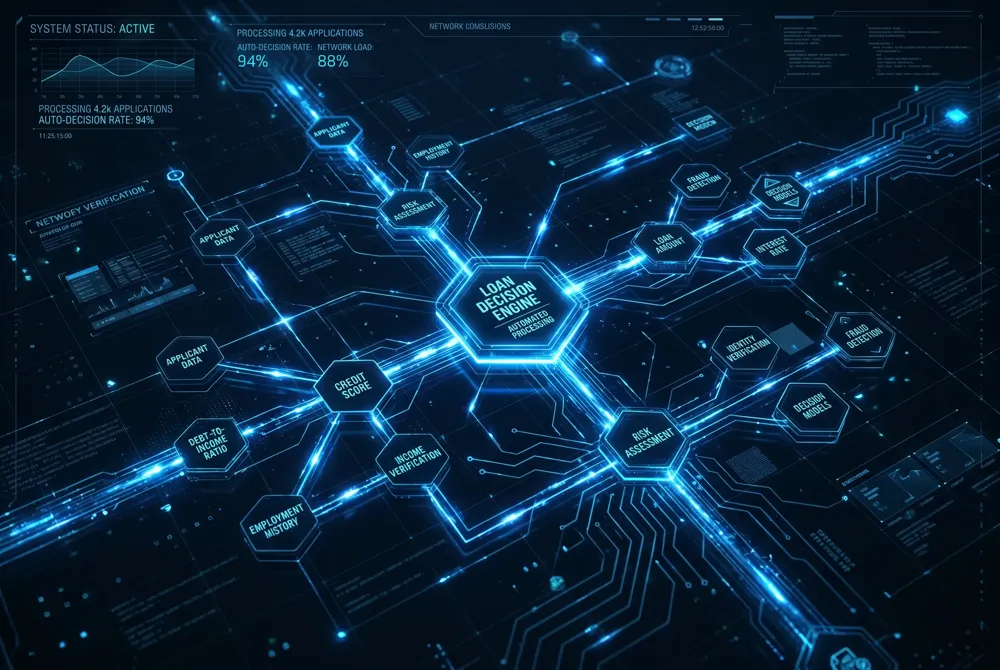
A typical LOS workflow begins with pre-qualification and application submission, followed by automated data collection, credit bureau checks, and document verification. The system then routes the application through underwriting, where rules engines can auto-decision based on core data fields or flag exceptions for human review. After approval, the platform manages closing documents, e-signatures, and funding disbursement, then transitions to servicing. This digital path ensures compliance, audit trails, and faster funding, often cutting approval times from days to minutes.
Modern LOS platforms incorporate customizable workflows, pre-built integrations, and AI-powered capabilities. Fuse's AI agents perform specific tasks: document reading and data extraction, document validation, fraud verification, outbound borrower communications, and auto-decisioning on any core data field including custom attributes and charge-off history. These agents apply configured rules and AI inference at the point of action, helping credit unions achieve faster, more consistent lending decisions without replacing human judgment.
How AI in Lending Enhances Loan Origination
AI in lending is not a single technology. It spans generative AI, machine learning, and narrow AI tools that each serve a distinct role inside a modern loan origination system. Generative AI can draft credit memos and synthesize borrower data. Machine learning models analyze thousands of variables to assess risk. Narrow AI performs specific tasks like reading documents and verifying fraud indicators.
Adoption is accelerating across the industry. By 2026, two-thirds of lenders will have completed or be implementing GenAI strategies, per a Celent study, and 83% plan to increase their GenAI budgets.
These investments are flowing directly into loan origination. AI automates underwriting by running credit applications through rules-based and inference-based decision engines. It processes documents at scale, extracting structured data from bank statements, tax forms, and pay stubs. It also monitors compliance continuously, flagging exceptions before they reach closing.
The typical Fuse client reaches approximately 71% automation in the first year by shipping small AI-driven automations each week. That happens because Fuse's AI agents handle document reading, data extraction, fraud checks, and outbound borrower communications within the platform, not as add-ons. For executives evaluating a loan origination system, the question is less whether AI works and more how much manual work the institution wants to keep doing.
Transforming Underwriting with Machine Learning
Machine learning is reshaping credit underwriting by processing far more data than traditional scorecards can handle. Where conventional models rely on fewer than 20 data points, AI-powered systems analyze hundreds or thousands of variables to build a more complete picture of borrower risk.
Third-party tools, like the Zest AI platform, illustrate the impact. It enables credit unions to analyze payment patterns, cash flow trends, and longer credit histories, supporting more accurate loan approvals. The FinRegLab reports that machine learning models can increase access to credit for millions of people, including disproportionately high numbers of Black, Hispanic, and low-income consumers who are difficult to assess using traditional models.
VyStar Credit Union reports that over 60% of loans using AI can be instantly approved, compared to about 30% with traditional digital lending. Upstart evaluates more than 1,000 data points per application for personal loans and auto loans. These outcomes show what is possible when an institution pairs AI with the right infrastructure.
But deploying advanced underwriting capability usually means layering a vendor's model onto an existing LOS, adding cost and integration complexity. A credit union on a Fiserv or Jack Henry core can turn on that capability without replacing its existing infrastructure, as Canopy Credit Union did after five years of being unable to auto-decision under its prior system. Fuse runs on top of those cores, delivering auto-decisioning on 100% of core data fields without replacing the underlying infrastructure. Request a 30-minute walkthrough of Fuse's AI-driven underwriting today.
Automating Document Processing and Data Extraction
Manual document processing remains one of the biggest bottlenecks in lending. Loan officers spend hours reading financial statements, pay stubs, and tax returns, checking for errors and entering data into systems. AI in lending has begun to eliminate that drag.
Generative AI can automate the reading of financial statements, a task prone to human error, and extract the relevant data more accurately and in minutes instead of hours. Tools like Ocrolus ingest unstructured documents such as bank statements and W-2s, convert them into structured regulatory-grade data, and feed those results directly into the loan origination system, combining AI extraction with human-in-the-loop validation to catch fraud.
The efficiency gains are measurable. Better Mortgage processes over 95% of its documents through Ocrolus to scale underwriting. An Entech client saw per-application document processing speed improve by roughly 60% after integrating Ocrolus for income verification. Google Cloud's Document AI for Lending also offers pretrained models for mortgage documents, accelerating data capture while supporting compliance controls.
For credit unions evaluating a modern LOS, the ability to automate document handling is no longer optional. A platform that replaces manual data entry with automated extraction and validation frees underwriters to review complex cases rather than rekey numbers. Fuse's AI agents perform this exact function with document reading and extraction, then apply configured rules and AI inference at the point of action, without requiring the model to learn or adapt over time.
AI-Powered Customer Service and Engagement
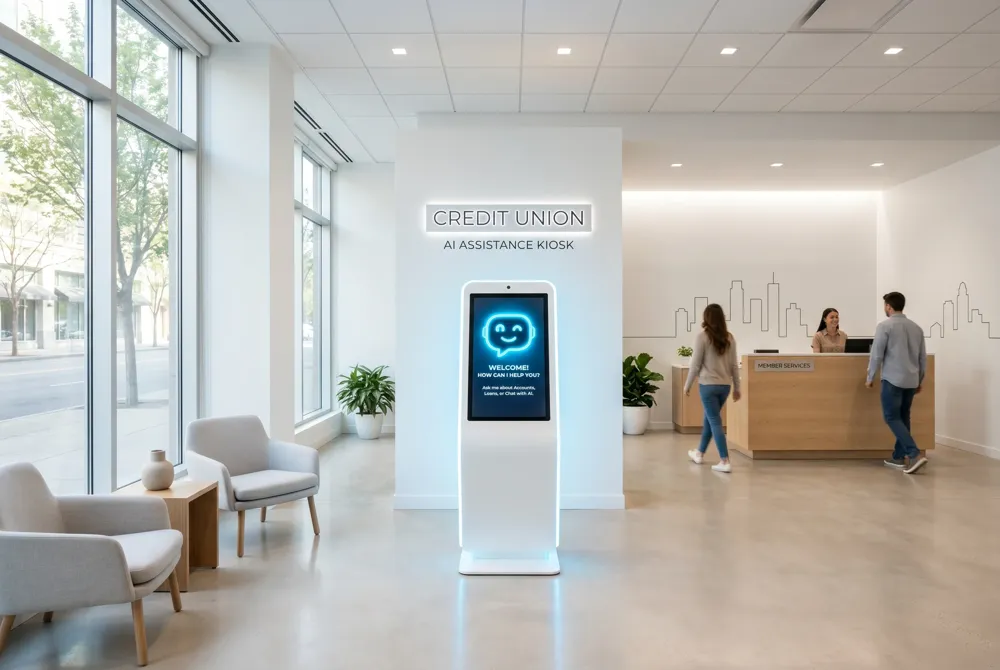
AI in lending is not limited to credit decisions. Modern loan origination systems now include chatbots and virtual assistants that handle member inquiries around the clock. By routing routine requests to automated agents, staff can focus on complex cases and relationship building. According to PwC, AI chatbots deliver instant, personalized support, freeing staff for complex cases. Fuse's platform includes an AI agent for outbound borrower communications, automating follow-ups and status updates.
Beyond support, AI in lending enables proactive engagement. By analyzing member transaction patterns and life events, the system can surface relevant loan offers before the member asks. This predictive capability deepens relationships and increases origination volume. A loan origination system with built-in AI can recommend products such as auto loans or home equity lines based on data triggers. Fuse's Automation Copilot, for example, identifies the next highest-impact workflow to automate, including member engagement tasks. As AI becomes the competitive baseline, institutions that embed it in the member experience will retain loyalty and grow portfolios.
Navigating Regulatory Compliance and Fair Lending
Regulators have made one thing clear: there is no AI exception to consumer protection laws. The CFPB requires lenders to provide specific, accurate reasons for any loan denial under the Equal Credit Opportunity Act (ECOA), whether the decision was made by a human or an algorithm.
This means any AI model used in credit decisions must be explainable. Institutions need an Explainable AI (XAI) layer that can generate legally defensible justifications, such as "denied due to debt-to-income ratio exceeding 50%." FinRegLab's research notes that explainability concerns shape every stage of model development, with firms often imposing upfront constraints like monotonicity for inherent interpretability.
AI models must also be blind to protected characteristics (race, gender, age, marital status) and cannot use proxy variables that indirectly correlate with them. The CFPB now requires dynamic, continuous monitoring to detect model drift that could lead to discriminatory outcomes. Static audits at launch are no longer sufficient.
Furthermore, financial institutions bear non-delegable responsibility for their AI agents' mistakes, even if errors stem from an external vendor's model update. A platform built with compliance in mind can reduce this risk. Fuse's single-tenant, SOC 2 architecture, combined with no-code rule configuration and a full audit trail, gives credit unions the controls they need to meet regulatory expectations while deploying AI agents for specific tasks like document validation and auto-decisioning on core data fields.
Evaluating Loan Origination System Vendors

Fuse: AI-Native, Built for Credit Unions
Fuse is an AI-native loan origination system designed specifically for credit unions, with secondary fit for community banks and finance companies. It replaces fragmented legacy stacks such as MeridianLink, Origence, and nCino with a single platform spanning the applicant portal, decision engine, document automation, agent workspace, and account opening. At Navigant Credit Union ($4B assets), Fuse powered a fully automated credit card program with end-to-end auto-decisioning on core data. Canopy Credit Union ($200M, a CDFI) turned on auto-decisioning after five years of being unable to under its prior LOS and expects 40% auto-decisions within six months.
Fuse's pricing is flat at $100,000 per year ($50,000 for smaller credit unions) with $0 implementation fees. Its Automation Guaranteed commitment covers three items: new integrations delivered in under one month at no extra cost, weekly product releases, and the ability to auto-decision on 100% of core data fields. The Proactive Automation operating model assigns each client a dedicated Automation Coach who meets every two weeks to identify the next highest-impact workflow to automate. On average, clients ship approximately 1% new automation per week, or roughly 71% in the first year.
Backbase and TurnKey Lender
Backbase offers an AI-powered Banking OS aimed at larger institutions, with strong digital engagement and omnichannel capabilities. TurnKey Lender provides strong automation for smaller lenders, focusing on credit decisioning and portfolio management. Both bring AI in lending to their respective segments, but neither targets the credit union market specifically.
Open Source Options
For institutions with development resources, open source alternatives exist. Frappe Lending is a 100% open source loan management system used by organizations such as Zerodha. DigiFi LOS on GitHub provides a configurable platform for managing loan processes. And Odoo offers a lending module within its ERP suite. These options give full control over customization but require significant engineering effort for deployment, integration, and ongoing compliance maintenance.
Which Vendor Fits Your Institution?
| Vendor | Best For | Differentiator |
|---|---|---|
| Fuse | Credit unions, community banks | AI-native, flat pricing, proactive automation, integration under 1 month guaranteed |
| Backbase | Large banks, multi-country institutions | Omnichannel Banking OS, strong digital engagement |
| TurnKey Lender | Smaller lenders, fintechs | Credit decisioning automation, portfolio tracking |
| Frappe Lending | Institutions with in-house dev teams | 100% open source, customisable lifecycle management |
| DigiFi LOS | Developers seeking configurable platform | GitHub-hosted, flexible workflow engine |
Loan Origination System vs. Loan Operating System
Most lenders know the traditional loan origination system as a pipeline tool. It handles intake, underwriting, and closing for a single product line. But today's lending environment demands more than a pipeline. The industry is shifting toward a loan operating system: a broader platform that orchestrates the entire lending workflow, from application to account opening.
A loan operating system is not a replacement for the LOS. It is a more comprehensive layer that sits above legacy systems and coordinates execution across the lending lifecycle. It includes components like an applicant portal, a decision engine, document automation, an agent workspace, and account opening. Where a traditional LOS manages one sequence of steps, an operating system manages the full organism of lending operations.
How a Loan Operating System Differs from a Traditional LOS
The differences fall into three categories: scope, integration, and intelligence.
Scope. A traditional LOS typically covers a single product or loan type. A loan operating system spans consumer, small business, and commercial lending on one platform. It also includes account opening, document management, and automated decisioning natively.Integration. Legacy LOS vendors charge fees for basic configuration changes and require months to add a new integration. A loan operating system ships with pre-built integrations and can add new ones in weeks. For example, Fuse's Automation Guaranteed commits to delivering new integrations in under one month at no extra cost.Intelligence. Traditional LOS platforms rely on static rules and manual reviews. A loan operating system includes AI agents that perform specific tasks: reading documents, validating data, verifying fraud, and auto-decisioning on core data fields. Fuse's AI agents execute these narrow functions within configured rules. They do not retrain themselves or refine logic from past outcomes.
| Capability | Traditional LOS | Loan Operating System |
|---|---|---|
| Scope | Single product pipeline | Multi-product, including account opening |
| Integration | Months to add, high cost | Weeks to add, flat pricing |
| AI | Manual or rules-based | AI agents for document reading, fraud check, auto-decisioning |
| Pricing | Implementation fees, variable tolls | $100K/year ($50K for small CUs), $0 implementation |
| Updates | Annual or less | Weekly releases |
Fuse as the Model for a Loan Operating System
Fuse was built as an AI-native loan operating system. It replaces fragmented legacy stacks like MeridianLink, Origence, or core-provided LOS modules from Jack Henry and Fiserv. The single platform spans the applicant portal, decision engine, document automation, agent workspace, and account opening. Fuse delivers flat pricing: $100,000 per year for most institutions and $50,000 for smaller credit unions, with $0 implementation and $0 variable fees.
The shift from LOS to loan operating system reflects a larger trend. A 2024 McKinsey Global Institute report estimated that GenAI could contribute between $200 billion and $340 billion in value across banking through productivity improvements alone. Institutions that wait for their legacy LOS vendor to catch up will watch that value flow to competitors.
For credit unions evaluating technology strategy, the question is no longer which LOS to buy. It is whether to upgrade to an operating system that unifies lending and puts AI to work on the tasks that consume staff time. Fuse demonstrates that this shift is not theoretical. It is live at over 100 institutions today.
Overcoming Integration and Implementation Challenges
Integrating AI tools with legacy core banking platforms, existing loan origination systems, and data warehouses is a top challenge for lenders adopting AI in lending. According to an EY report, mortgage lenders cite complexity and disruption to existing infrastructure as primary concerns about GenAI implementation. Poor data quality also undermines model accuracy, making data governance a prerequisite for any AI initiative.
Institutions should start with high-ROI, lower-risk use cases such as fraud detection, document processing, or automated member support. Cross-functional teams that include model, technology, legal, compliance, and risk stakeholders are essential for successful deployment. Continuous monitoring of model performance and data drift is required to maintain compliance and accuracy over time.
Fuse directly addresses these integration challenges. Its Automation Guaranteed contractually commits to delivering new integrations in under one month at no extra cost. The platform sits on top of existing core systems, meaning credit unions can adopt AI without replacing their backend infrastructure. This approach reduces complexity and accelerates time to value.
Measuring the Impact: Efficiency and Accuracy Gains
The most direct evidence for AI in lending comes from real institutions. Vibrant Credit Union, processing indirect loans through the Dravada CUSO, cut funding time from three days to 1.2 minutes and grew indirect volume over 40%. Navigant Credit Union launched a fully automated credit card program with end-to-end auto-decisioning on core data. Canopy Credit Union, a CDFI, is on track to reach 40% auto-decisions within six months after years of being unable to automate under their prior LOS. These outcomes show what a modern loan origination system equipped with AI agents can achieve.
On the document processing side, AI agents extract and validate data from tax returns, pay stubs, and bank statements in seconds.
For credit unions, these gains translate into faster decisions, higher auto-decision rates, and lower operational overhead.
Fuse's Proactive Automation model helps clients achieve approximately 1 percent new automation per week, or roughly 71 percent in the first year on average. These are average customer outcomes, not contractual guarantees. The combination of flat pricing, weekly releases, and an Automation Coach ensures that the efficiency improvements keep compounding. For credit unions that have experienced vendor lock-in and hidden fees, this represents a fundamentally different approach to measuring return on investment.
The Future of AI in Lending: From Adoption to Baseline
AI in lending has moved past the experimentation phase. A 2025 PwC analysis found that banks fully embracing AI could see up to a 15-percentage-point improvement in their efficiency ratio, driven by revenue growth from personalized engagement and cost reduction through intelligent automation.
Realizing those gains requires investment in AI infrastructure, data governance, and responsible AI oversight. PwC notes that institutions that invest in data governance, interoperability, and explainability will deploy AI more effectively, predicting up to a 25% improvement in decision-making speed and accuracy.
The workforce must shift from execution to oversight. As AI agents automate routine tasks like document reading and fraud verification, staff move to managing AI workflows and handling exceptions. PwC predicts up to 50% of middle-office staff could transition to higher-value roles.
For credit unions, the window to treat AI as an optional edge is closing. Vendors that deliver narrow, configured AI agents without continuous-learning claims, and do so at flat, predictable pricing, will define the next competitive baseline. Fuse ships weekly product releases and delivers, on average, approximately 1% new automation per week for clients through its Proactive Automation model.
Embracing AI as the Competitive Baseline
AI in lending has moved from optional to essential. Financial institutions that have adopted AI tools are seeing measurable gains in speed, accuracy, and member satisfaction. Those that have not are falling further behind.
The choice for credit unions and community banks is no longer whether to invest in AI, but how quickly they can implement it. Legacy systems and manual workflows cannot keep pace with member expectations for instant decisions and seamless digital experiences. Fintechs now hold nearly 40% of consumer loan market share, a figure that underscores the urgency for traditional lenders to modernize.
Platforms built for this new standard exist today. Fuse, for example, gives credit unions an AI-native loan origination system that replaces fragmented legacy stacks with a single automated workflow. The typical Fuse client ships approximately 1% new automation per week, reaching roughly 71% automation in the first year. At Navigant Credit Union, a fully automated credit card program runs on end-to-end auto-decisioning. Vibrant Credit Union cut funding time from three days to 1.2 minutes through its Dravada CUSO. These are not future possibilities. They are current outcomes.
The industry benchmark has shifted. A 2024 McKinsey Global Institute report estimates that GenAI could contribute between $200 billion and $340 billion in value across banking through productivity improvements alone. Meanwhile, the cost of inaction grows as members increasingly expect the speed that AI enables. Institutions that adopt AI now will define the competitive landscape for the next decade. Those that wait will struggle to catch up.
AI in lending is not just an advantage. It is the baseline for any institution that intends to grow, serve its members, and remain relevant.
See how Fuse delivers on this standard. Read the Canopy Credit Union case study or request a 30-minute walkthrough.
Related articles
How AI in Lending Is Changing Loan Origination for Banks
What Digital Transformation in Banking Means for Loan Origination and Underwriting

LOS & POS Integration: 5 Advantages to Merge Them
Ready to meet the AI-powered Loan Origination System?

