What is core banking and how does it power your daily banking experience?

The System Behind Daily Banking
A member’s deposit, withdrawal, or loan payment may take seconds, but each depends on systems that record account activity and process transactions accurately. For credit union leaders, the core is not an abstract technology layer. It is the operational foundation behind daily service.
A core banking system connects branches and channels to shared account records. It supports functions such as deposits, withdrawals, loan processing, and financial recordkeeping. The Federal Reserve Bank of Kansas City’s overview describes core systems as the operational backbone of banks and credit unions.
That foundation matters to the member experience, but it does not need to own every workflow. Fuse handles lending and account-opening processes alongside a credit union’s core, keeping transaction records and specialized lending operations distinct.
What the Core Banking System Does
A core banking system is the central platform a credit union uses to maintain member and account records and process routine activity, including deposits, withdrawals, and balance updates. It serves as the system of record for account and transaction activity, a role described in the Kansas City Fed’s overview of core banking services.
Websites, mobile apps, and staff tools provide ways to access services. They send requests to the core, which checks and processes the activity. For example, when a member requests a withdrawal at a branch, the branch system sends the request to the core. The core authenticates and processes it, then updates the account record.
Core capabilities may also include account management, loan processing, and reporting that supports financial and regulatory records. The core’s role differs from a loan origination system (LOS): the core maintains account and transaction records, while the LOS manages application intake, underwriting workflows, and lending decisions.
Fuse is an LOS and account-opening platform, not a core banking system. Credit unions can run it on top of their existing core, keeping account records in place while configuring lending workflows in Fuse. Its platform includes document reading, fraud verification, and auto-decisioning on core data fields.
A credit union may host its core on premises or use a cloud-based arrangement. The choice depends on institutional resources, operating requirements, and modernization plans. The Kansas City Fed’s discussion of core modernization options examines the considerations institutions face as they assess their core systems.
How the Core Connects to Lending
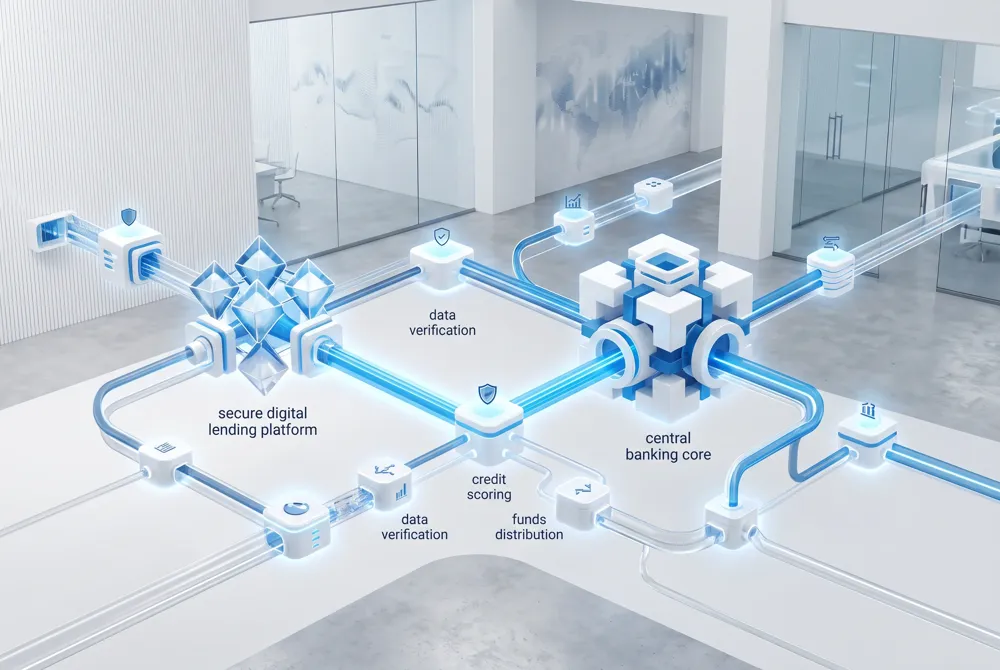
A credit union’s core keeps the official records for members, accounts, transactions, and booked loans. A loan origination system (LOS) manages a different part of the work: application intake, decisioning, document collection, and approval workflows. The Kansas City Fed’s overview of core banking systems describes the core’s institution-wide role in managing accounts and processing loans.
A typical connection lets the LOS retrieve relevant core data for a lending decision. When a loan is approved, the LOS can send approved loan details back to the core for booking. That outline is not a universal integration pattern. The systems in place, configuration, and lending process determine which records move, when they move, and how the connection responds to missing or conflicting data.
Before implementation, lending, operations, and technology leaders should agree on how records, exceptions, and handoffs will be managed. Confirm which system owns each field, who resolves failed transfers, and how staff can identify a loan that needs review. These details affect daily operations as much as the initial data exchange.
Fuse runs on top of an existing core, including Fiserv, Jack Henry, and Corelation, with more than 200 pre-built integrations. Its core banking integration approach connects lending workflows with core data, including for decisioning and funding. This lets credit unions add an LOS without replacing the system that maintains their account and transaction records.
Where Core Lending Modules Can Fall Short

When lending work is spread across separate tools for applications, documents, decisions, and member communications, staff often have to move information between systems and monitor handoffs manually. The core can remain the institution’s system of record, but the surrounding workflow may still be fragmented.
Limited workflow configuration adds friction. If changing a lending process requires technical work, teams may struggle to automate routine steps or respond quickly to policy and product changes. Manual review and repeated data entry can slow decisions and funding, leaving staff less time for complex cases and member service.
Core providers may also supply services beyond account and transaction processing, which can deepen an institution’s reliance on one vendor relationship. The Kansas City Fed’s 2024 briefing on core banking providers notes that provider contracts, fees, and integration concerns can affect institutions’ ability to add services or make changes.
A credit union does not have to replace its core to address lending workflow gaps. Fuse replaces fragmented lending stacks, including core-provided LOS modules, while running on top of the institution’s core. Its no-code configuration lets business users adjust rules, workflows, and screens, and its AI agents handle defined tasks such as document extraction, validation, and fraud checks. This keeps account records and transaction processing in the core while giving lending teams a separate system for origination and account opening.
Evaluating Lending Technology Around the Core

A loan origination system should fit the credit union’s lending process and connect cleanly to its core. The Kansas City Fed’s discussion of core modernization options examines how institutions assess their core systems.
Evaluate the full path from application intake through decisioning, document handling, staff review, and account opening. Check which core data the system can use, how it sends approved loan details back, and what staff must do when an application needs manual attention.
Fuse brings these lending and account-opening workflows into one platform, with no-code configuration. Its AI agents perform defined tasks, including extracting document data, performing fraud checks, and auto-decisioning against core data. Fuse is a lending workflow platform, not the system that maintains institution-wide account and transaction records.
Map the handoffs before choosing a system. The core should remain the source for account records and daily transactions, while the lending platform manages applications and decisions. Clear connections help staff avoid duplicate entry and keep approved lending activity aligned with member records. For a closer look at how core integration supports lending workflows, see Fuse’s guide to core banking system integration.
Keep the Core and Workflows Distinct
The systems should exchange relevant data, but they serve different jobs, as the Kansas City Fed explains in its overview of core banking systems.
For a practical review, map what data moves between the core and lending tools, where staff re-enter information, and which handoffs need a clearer workflow. Fuse gives credit unions a way to address process gaps in lending and account opening.
Request a 30-minute Fuse walkthrough focused on how an LOS can run on top of your existing core.
Related articles

How to Find Commercial Lending Software That Integrates With Your Bank Loan Software
What is core banking and how does it power your daily banking experience?
How to compare loan origination platforms and pick the right one for your bank
Ready to meet the AI-powered Loan Origination System?

