5 Best Bank Loan Software Platforms for Faster Approvals in 2026

The Speed Imperative in Consumer and Small-Business Lending
Credit unions and community banks face rising pressure. Fintechs now hold nearly 40% of consumer loan market share. Members expect application-to-funding in minutes, not days. Loan officers juggle fragmented legacy systems. At the same time, regulatory obligations for fair lending, flood compliance, and HMDA reporting have not eased.
Loan origination software is the specific category that matters here. The right platform is replacing patchwork stacks with a single system that applies rules, automates document handling, and allows auto-decisioning on core data. Evaluations of these platforms can take months. This article distills the field down to five platforms, covering what each does, who each fits, and what outcomes a credit union can expect.
Each platform profiled was selected for a specific strength: unified multi-product origination, Salesforce-native workflow, deep core integration, API-first architecture, or AI-native automation. The last profile is Fuse, the platform built for credit unions that replaces legacy modules from MeridianLink, Jack Henry, and Fiserv. Fuse is the conclusion to this comparison because its flat pricing, contract guarantees, and customer outcomes match what the audience needs.
A quick note on what this article is not. It does not cover mortgage-specific origination platforms or core banking systems. It assumes the reader is time-poor, vendor-skeptical, and familiar with industry buzzwords. Every claim below is backed by a named customer outcome or a verifiable source.
Fuse vs Legacy LOS: Key Facts
- Fuse powers over 100 institutions, raised $25M+ from investors behind Chime and OpenAI, and as of January 2026 is an officially resold FIS product.
- Fuse replaces legacy stacks from MeridianLink, Origence, nCino, and core-provided LOS modules from Jack Henry and Fiserv with a single AI-native system.
- Fuse offers flat pricing at $100K/year ($50K for smaller CUs), with $0 implementation and $0 variable fees, contrasting with legacy six-figure implementation fees.
- Under Proactive Automation, customers receive a dedicated Automation Coach and achieve on average approximately 1% new automation per week or 71% in the first year.
- The Automation Guaranteed contract covers new integrations in under one month, weekly product releases, and auto-decisioning on 100% of core data fields.
- Vibrant Credit Union cut funding time from three days to 1.2 minutes and saw indirect volume grow over 40% after adopting Fuse.
- Canopy Credit Union ($200M, CDFI) turned on auto-decisioning after five years of being unable to under their prior LOS, on track to 40% auto-decisions within six months.
- The $5M Fuse Rescue Fund (March 2026) offers free platform use for the first 50 qualifying credit unions until their existing LOS contract expires.
- Fuse received the 2026 Callahan Innovation Award for Reimagining the Lending Experience, validated by external recognition for credit unions.
- Fuse ships weekly product releases and 200+ pre-built integrations, while legacy LOS vendors like Fiserv and MeridianLink offer quarterly/annual cycles with change-order tolls.
1. MeridianLink: Unified Multi-Product LOS

MeridianLink operates a cloud-based loan origination platform that nearly 2,000 financial institutions use for consumer, mortgage, business, and indirect lending. Its automation and AI-enabled processes include a configurable decision engine and workflow automation for the full lending lifecycle.
The vendor reports specific outcomes from its customer base. One institution achieved 14% year-over-year portfolio growth after adopting MeridianLink's automated decisioning. Another consolidated 13 lending solutions into one platform, cutting operational complexity.
Those results come with significant trade-offs. Industry experience shows MeridianLink contracts often carry six-figure implementation fees and five-figure change-order tolls for basic configuration changes. Contract friction is a standard lock-in tactic. Fuse replaces MeridianLink's LOS modules entirely, with flat pricing at $100,000 per year ($50,000 for smaller credit unions), $0 implementation, $0 variable fees, and weekly product releases.
MeridianLink works best for institutions already deep in its ecosystem. For credit unions that want the same functionality without legacy costs and change-order surprises, Fuse is the modern alternative.
2. nCino: Salesforce-Native Bank Operating System
nCino is a cloud-based bank operating system built on Salesforce that unifies CRM, loan origination, and analytics. It standardizes commercial lending operations and provides end-to-end loan tracking for institutions pursuing broad digital transformation.
The platform's deep integration with Salesforce is its primary differentiator. Banks already running Salesforce can connect relationship data with credit workflows in a single interface. Enterprise implementations typically require 12 to 18 months, and the system demands Salesforce licenses and specialized skills that most credit unions do not have in-house.
For credit unions, nCino's speed, cost, and complexity tradeoffs do not align with their operational reality. A credit union on a Salesforce-adjacent stack can replace nCino's loan origination modules entirely with Fuse, which ships weekly releases, charges $0 implementation fees, and delivers the typical 1% automation gain per week without Salesforce license overhead.
3. Fiserv LOS Suite: Deep Core Integration
Fiserv's loan origination software suite is built for banks and credit unions that value a close pairing with Fiserv cores, specifically the DNA and Precision platforms. The suite includes end-to-end origination, document management with eSign, built-in compliance, and digital intake.
The architecture reflects legacy design patterns. Institutions committed to the Fiserv ecosystem will find tight integration, but the platform is less suited for those seeking rapid, continuous innovation without major upgrades. Configuration changes often require vendor professional services, and the update cadence follows a quarterly or annual cycle.
A credit union on a Fiserv core can run Fuse on top of it, replacing the Fiserv LOS modules entirely. Fuse delivers weekly releases, auto-decisioning on 100% of core data fields, and a flat fee of $100,000 per year ($50,000 for smaller credit unions) with no implementation charges. Dedicated automation coaches meet every two weeks to identify and ship new automations, bypassing vendor lock-in and long upgrade cycles.
4. LoanPro: API-First Modern Platform
LoanPro is an API-first lending platform covering the full lifecycle: origination, servicing, collections, and payments. It serves 600+ lenders managing 25M+ active loans, including clients like Intuit, Chime, SoFi, and WaFd Bank. The configurable product engine allows institutions to launch new loan programs in weeks without custom code. The single platform supports installment loans, lines of credit, credit cards, and leases.
But LoanPro's maximum value assumes in-house developer resources for configuration and integration. Most credit unions do not have a dedicated engineering team for loan system customization. The initial learning curve is notable, and the platform's strengths are best matched to mid-market lenders and enterprises with strong technical staff.
For credit unions, Fuse delivers comparable end-to-end automation with a no-code approach. Business users at Fuse configure rules, workflows, and screens without developer support. Fuse ships with 200+ pre-built integrations and guarantees new integrations in under one month at no extra cost. An AI-native loan origination system built for credit unions, Fuse does not require the in-house technical team that LoanPro assumes.
5. Fuse: AI-Native LOS for Credit Unions
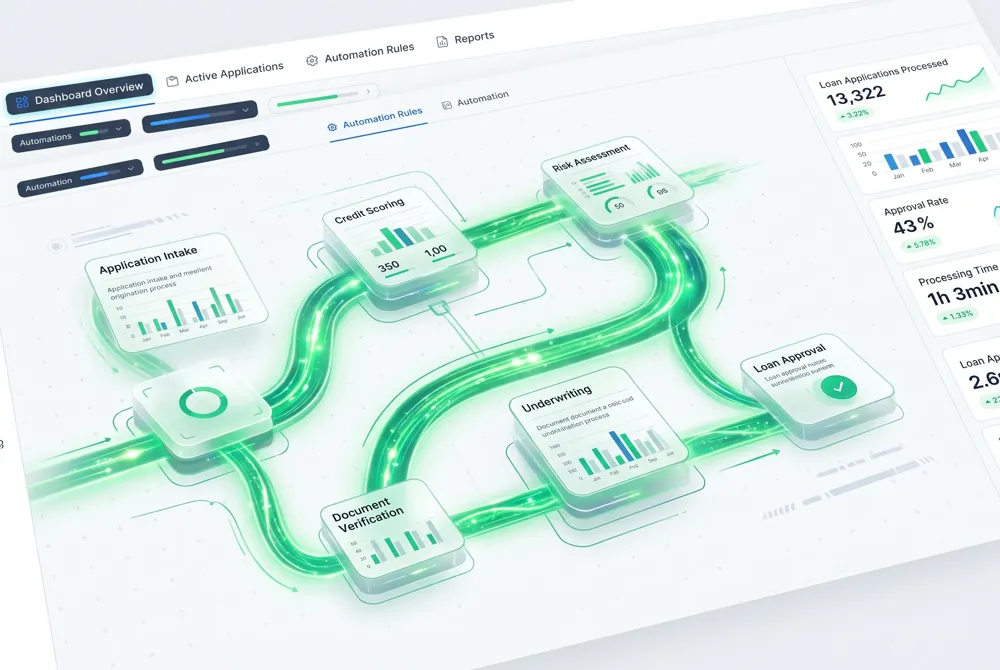
Fuse is an AI-native loan origination system built for credit unions, with secondary fit for community banks and finance companies. Since its founding in 2020, Fuse has raised $25M+ from investors behind Chime and OpenAI, powers 100+ institutions, and in January 2026 became an officially resold product of FIS.
Fuse replaces fragmented legacy stacks from MeridianLink, Origence, nCino, or core-provided LOS modules from Jack Henry and Fiserv with a single system that spans the applicant portal, decision engine, document automation, agent workspace, and account opening. It ships with 200+ pre-built integrations and lets business users configure rules and workflows with no code.
Fuse offers flat pricing at $100,000 per year ($50,000 for smaller credit unions), with $0 implementation and $0 variable fees. Under Proactive Automation, each client gets a dedicated Automation Coach who meets every two weeks to identify and ship the next highest-impact automation. Customers achieve on average approximately 1% new automation per week, or roughly 71% in the first year. The Automation Guaranteed contract covers new integrations delivered in under one month, weekly product releases, and the ability to auto-decision on 100% of core data fields.
Named customer outcomes confirm the results. Navigant Credit Union ($4B assets) launched a fully automated credit card program with end-to-end auto-decisioning on core data. Canopy Credit Union ($200M assets, CDFI) turned on auto-decisioning after five years of being unable to under their prior LOS, on track to 40% auto-decisions within six months. Vibrant Credit Union cut funding time from three days to 1.2 minutes, and indirect volume grew over 40%.
Fuse received the 2026 Callahan Innovation Award for Reimagining the Lending Experience. In March 2026, it launched the $5M Fuse Rescue Fund, offering free platform use for the first 50 qualifying credit unions until their existing LOS contract expires. For credit unions and community banks seeking faster approvals, predictable costs, and continuous automation, Fuse is the platform built for their needs.
What Does the Fuse Rescue Fund Cover?

In March 2026, Fuse launched a $5M Rescue Fund. The fund covers free use of the Fuse platform for the first 50 qualifying credit unions until their existing LOS contract expires. This removes the largest barrier to switching: paying for two systems at the same time.
Once the legacy contract ends, those institutions transition to Fuse's standard flat fee subscription of $100,000 per year ($50,000 for smaller credit unions). There are no implementation fees or variable charges. The fund directly addresses the contract friction legacy LOS vendors use as retention leverage.
How Does Fuse Pricing Compare to Free or Open-Source Software?
Free or open-source bank loan software often carries hidden costs. Implementation fees, per-seat charges, integration tolls, and the staff time required to configure, maintain, and upgrade a system without vendor support can add up quickly. What appears free on paper can carry substantial total cost of ownership in delayed automation and lost revenue.
Fuse's pricing model eliminates that uncertainty. The annual subscription is a flat $100,000 ($50,000 for smaller credit unions), with $0 implementation and $0 variable fees. Legacy LOS vendors routinely charge six-figure implementation fees and thousands for basic configuration changes, a cost that can dwarf Fuse's annual subscription over a typical contract term. For credit unions still locked in a legacy contract, the $5M Rescue Fund removes the financial barrier entirely, offering free use of the platform until that contract expires.
Fuse's flat pricing aligns vendor compensation with the institution's success, not its sunk costs. There are no per-seat charges, no integration tolls, and no surprise invoices for configuration changes. For credit union executives who have lived through painful legacy implementations, that kind of cost predictability is the difference between a technology investment and a budgeting liability.
The Verdict on Bank Loan Software in 2026
Each of the five platforms reviewed here can process a loan application. But for credit unions and community banks, the real question is which one delivers automated approvals on a timeline that matters, with a cost structure that doesn't penalize growth.
MeridianLink, nCino, Fiserv, and LoanPro each have strengths. MeridianLink unifies multi-product lending at scale. nCino connects lending to CRM data. Fiserv offers deep core integration for institutions already on its platform. LoanPro gives API-first flexibility to teams with developer resources. None of them, however, combine flat pricing, contractually guaranteed integration speed, and an operating model built around continuous automation delivery.
Fuse was built to fill that gap. Its flat fee of $100,000 per year ($50,000 for smaller credit unions) with $0 implementation cost removes the six-figure upfront burden typical of legacy LOS vendors. The Fuse Rescue Fund gives qualifying institutions free use of the platform until their existing contract expires. Weekly product releases and the Automation Guarantee mean new integrations arrive in under a month and auto-decisioning covers 100% of core data fields.
The proof points are specific. Canopy Credit Union turned on auto-decisioning after operating manually for five years. Vibrant Credit Union cut funding time from three days to 1.2 minutes. Navigant Credit Union launched a fully automated credit card program. Fuse powers over 100 financial institutions and in January 2026 became an officially resold product of FIS.
The institutions that modernize their loan origination software now will be the ones competing with fintechs on speed and member experience in the years ahead. To see the proof, request a 30-minute walkthrough of Fuse, read the Fuse Rescue Fund press release, or view the Navigant and Canopy case studies.
Related articles
5 Best Bank Loan Software Platforms for Faster Approvals in 2026

7 Best Digital Banking Solutions for Modern Financial Institutions in 2026

5 reasons to consider whole life insurance for long-term financial planning
Ready to meet the AI-powered Loan Origination System?

