How Do Loan Origination Platforms Use AI to Review Loan Applications?
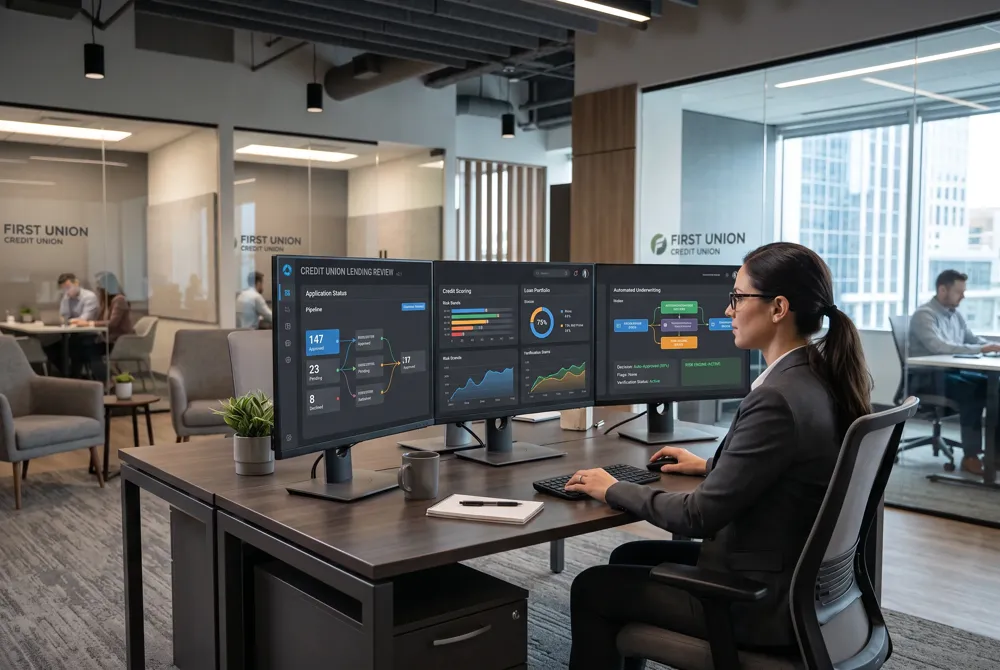
AI Enters the Loan Review Workflow
Which parts of application review can AI handle, and where should credit union staff retain judgment? That is the practical question behind evaluating loan origination platforms. The answer depends less on broad claims about artificial intelligence than on the specific work a system is authorized to do.
AI can support defined tasks such as reading documents, checking for inconsistencies or fraud signals, routing exceptions, and applying configured decision rules. These functions can reduce repetitive handling, but they do not replace lending policy, compliance controls, or staff judgment on complex cases. A flagged signal is a reason to review, not proof of fraud.
The sections ahead explain how loan origination platforms organize these tasks, what executives should assess in a workflow, and where human review belongs. Fuse, built for credit unions, assigns AI agents narrow roles such as document reading, fraud verification, and auto-decisioning against configured rules. Its system can auto-decision on core data fields, while the institution sets the policies and oversight that govern lending.
What Loan Origination Software Does

Loan origination software manages a loan from application through decisioning and funding. For a credit union, it connects the steps that often sit across separate systems, from collecting member information to giving lending staff a decision or moving an approved loan toward funding.
Loan origination platforms typically bring four functions into one workflow: an application portal, a decision engine, document processing, and a staff workspace. The portal captures application details. Document tools read and check supporting files. The decision engine applies the credit union’s configured policies to application and core data. Staff use the workspace to review cases, resolve exceptions, or act on a recommendation.
A typical workflow starts with application and core data collection, followed by document verification and rule-based review. Depending on the credit union’s policies and setup, the system may route a case to staff or automate a decision. Automation does not remove the institution’s responsibility for its lending criteria or for reviewing exceptions.
Fuse brings these lending functions together with account opening and more than 200 pre-built integrations. Its AI agents perform defined tasks, including document reading, fraud verification, outbound communications, and auto-decisioning on core data fields. Business teams can configure rules and workflows without code, while staff retain a workspace for cases that need attention.
AI Tasks in Underwriting
Credit unions can use AI to handle defined underwriting tasks, including reading and validating documents, flagging potential fraud, routing applications, and applying configured decision rules. Loan origination platforms can bring these steps into one workflow, while staff retain responsibility for exceptions and policy oversight.
At Fuse, AI agents read documents, verify fraud signals, support borrower communications, and apply configured rules to core data. Credit unions can set decision criteria using any core data field, including custom attributes and charge-off history. The institution keeps control of its underwriting policy rather than handing that policy to a model.
Automation is only as dependable as the information it receives. Incomplete records, inconsistent data, or extraction errors can lead to poor routing or decisions. Credit unions should validate inputs, test outcomes, document decision reasons, and monitor results for errors or unfair patterns. The institution remains responsible for lending decisions and compliance, even when software performs parts of the review.
These distinctions matter when evaluating AI claims. Fuse’s agents perform narrow, configured tasks. They do not claim to train themselves on past loan outcomes or change decision logic as they process applications. That makes it important to assess the rules, data sources, exception paths, and staff controls behind each automated action, not just the speed of a product demonstration.
For a practical example, Fuse’s loan underwriting automation guide describes how agents can handle document reading, fraud verification, and auto-decisioning against configured rules. A walkthrough of those workflows can help lending and technology leaders test fit against their own policies and core data.
Document Checks and Fraud Signals
Loan origination platforms can use AI to sort incoming files, extract fields, check required documents, and compare information across an application. That can cut repetitive handling, but document formats vary and extracted values can be wrong. A misclassified file or inaccurate field may create rework rather than remove it.
A useful workflow separates routine checks from uncertain cases. The system can flag missing information, conflicting values, or unusual signals, then route those items to staff. A fraud flag is a prompt to investigate, not proof of fraud. Human review matters when a document is unclear or an apparent inconsistency has a legitimate explanation.
At Fuse, AI agents perform defined application tasks: document reading, validation, and fraud verification. They apply configured rules and AI inference at the point of action. They do not learn from past loan outcomes or change decision logic over time. Fuse can also apply configured decision rules to core data fields, with staff attention reserved for exceptions.
The distinction matters when evaluating automation. Ask whether a platform can show which fields it extracted, identify incomplete or inconsistent files, and send uncertain cases to the right employee. A clean handoff is more useful than an opaque flag that leaves staff to repeat the entire review. Fuse’s loan origination software brings document automation and fraud verification into the lending workflow, alongside configured decisioning.
Keep People in Consequential Decisions

Will AI replace loan underwriters or mortgage loan officers? Usually, the practical role is narrower: loan origination platforms can handle defined tasks, while staff retain responsibility for judgment that depends on context.
Canopy Credit Union shows how automation can expand without removing human oversight. After five years without auto-decisioning under its prior LOS, the CDFI enabled the capability and is on track to reach 40% auto-decisions within six months. That target is Canopy’s reported trajectory, not a general benchmark for other institutions.
Underwriters and loan officers still matter when an application falls outside policy, carries elevated risk, or presents conflicting information. They interpret policy, assess exceptions, and speak with members when the decision or next step needs explanation. Automation can reduce repetitive review, but it cannot substitute for institution-specific judgment in these cases.
The credit union defines the boundary. Leaders should decide which products, application types, and decision outcomes can proceed automatically, and which require staff review. Those rules should also specify how uncertain information, policy exceptions, and potential fraud flags move to an employee.
Fuse’s agents perform bounded tasks such as document reading, fraud verification, and auto-decisioning against configured rules. Its platform can apply those rules to core data fields, while the institution controls where human review applies. That distinction lets teams automate routine decisions without treating every application as a candidate for automatic approval.
The right measure is not whether a platform removes underwriters. It is whether staff spend less time on routine work and more time on cases that need expertise. Credit unions can assess that balance by reviewing referral patterns, exception handling, and employee feedback as automation expands.
Controls for AI-Assisted Lending
Loan origination platforms can apply configured rules and route applications, but the credit union remains accountable for its lending decisions. Fuse’s AI agents handle defined tasks such as document reading, fraud verification, and auto-decisioning against institution-configured rules. They do not transfer compliance responsibility to a technology provider.
The Consumer Financial Protection Bureau’s guidance on adverse action and artificial intelligence makes clear that there is no AI exception to consumer-protection laws. When a credit union denies an application, it must provide specific, accurate reasons that satisfy applicable adverse-action requirements. A generic model score or an explanation that does not reflect the actual decision is not enough.
Fair-lending review should examine both protected characteristics and variables that may act as proxies for them. Device type, location, or purchasing patterns may warrant scrutiny when they influence decisions. Review outcomes across relevant population segments, products, and channels to spot uneven patterns, not just overall approval rates.
A launch-time review is only a starting point. Credit unions should monitor model performance and decision outcomes as portfolios, applicant populations, and economic conditions change. Maintain records of the data considered, rules applied, decision reasons, overrides, and exceptions so staff can reconstruct and explain how an application was handled.
Controls also depend on sound data governance. Inaccurate, incomplete, or biased data can weaken decisions, while lending files contain sensitive member information that requires appropriate access and security safeguards. Set clear permissions for systems and staff, and define when uncertain or unusual cases must go to a human reviewer.
Vendors can provide tools, audit logs, and technical controls, but the credit union cannot outsource accountability for errors or unfair outcomes. Fuse’s configured workflows can automate specific steps while leaving the institution responsible for its policies, oversight, and final governance.
Compare Platforms Beyond the Demo
Canopy Credit Union’s experience offers a customer example to examine when assessing whether a platform can support a credit union’s own policies, data, and workflows.
When comparing loan origination platforms, assess the work they support from application intake and decisioning through document handling and staff work queues. A polished demo can show a smooth path through a prepared scenario. It cannot establish how the platform will handle the credit union’s own policies, data, exceptions, and day-to-day operations.
Test connections to the core, existing LOS tools, and data stores. Confirm which integrations are ready and which require custom work. Ask whether business users can change rules and workflows without code, and whether automation can use the core data fields the credit union relies on. Fuse states that its platform includes more than 200 pre-built integrations and supports auto-decisioning on core data fields.
Implementation effort deserves the same scrutiny as feature lists. Integration with legacy systems can create delays and added work, so ask who owns each connection, how exceptions are handled, and what support is included. Compare recurring costs with implementation fees and variable charges, then review security architecture, release cadence, and vendor commitments in writing.
Fuse states that its infrastructure is single-tenant and SOC 2 compliant, with weekly product releases. Its flat annual price is $100,000, or $50,000 for smaller credit unions, with no implementation or variable fees. These terms give decision-makers concrete points to compare against a proposal’s full cost and delivery commitments.
Use customer stories such as Canopy’s to test whether a vendor can support the outcome it describes, but ask how the institution’s own policies, products, and core data would affect the result. For credit unions replacing fragmented legacy workflows, Fuse brings application intake, decisioning, document automation, and staff workflows into one platform.
What the Automation Guaranteed Commitment Covers

For credit unions comparing loan origination platforms, contract language matters. Fuse’s Automation Guaranteed commitment defines what the institution can expect from the product, without turning an average operating result into a promise.
The contract covers three items: new integrations delivered in under one month at no extra cost, weekly product releases, and the ability to auto-decision on 100% of core data fields. It does not guarantee a specific automation rate.
That distinction matters when evaluating automation claims. A contract can specify product commitments, while actual automation depends on the credit union’s workflows, policies, and use of the platform.
Separately, Fuse customers achieve approximately 1% new automation per week on average, or roughly 68% in the first year. Those figures describe average customer outcomes, not contractual guarantees. Fuse supports the work through a dedicated Automation Coach who meets with each client every two weeks to identify and ship the next high-impact automation.
Choose Automation With Clear Boundaries
Evaluate loan origination platforms by the work they automate, the data and systems they access, the controls around decisions, and the evidence the vendor can show. A polished demo cannot answer whether the workflow fits your lending policy or routes exceptions to the right staff.
Automation should reduce repetitive review, not transfer accountability. The credit union remains responsible for its policy, oversight, and consequential lending decisions. Fuse’s AI agents handle defined tasks, including document reading, fraud verification, and auto-decisioning against configured rules.
For a practical review, request a 30-minute walkthrough of Fuse. Examine a lending workflow, integrations, and the contractual automation commitments: new integrations in under one month at no extra cost, weekly product releases, and the ability to auto-decide on all core data fields.
Related articles

What Are the Pros and Cons of Whole Life Insurance?

5 Things That Affect the Cost of Term Life Insurance

How Loan Origination Software Handles Indirect Auto Lending From Dealer Application to Funding
Ready to meet the AI-powered Loan Origination System?

